Western Australia
The Colour Out of SpaceWestern Australia is where Nathaniel Wingate Peaslee’s search for the sources of his recurring dreams reaches its most consequential and unresolved point. In 1935, a university expedition entered the remote desert to investigate reports of ancient masonry; its discoveries seemed to confirm Peaslee’s images of a lost civilization, while his later account of what lay beneath the ruins remained impossible to verify.
Setting and approach
The expedition’s destination lay in an arid region of sand and rock, reached from Pilbarra by motor tractor or, as an alternative, by bringing equipment upriver on the De Grey River. Robert B. F. Mackenzie, the mining engineer whose letter prompted the project, placed the stones roughly 100 miles southeast of Joanna Spring, west and south of Warburton’s 1873 path, at about 22° 3' 14" south latitude and 125° 0' 39" east longitude. He described a tropical climate and difficult desert conditions, and recommended that an expedition travel in the winter months.
The location had already acquired a reputation among people familiar with it. Mackenzie reported that local Aboriginal people had an intense fear of the particular site. He had also shown photographs of the stones to the government at Perth, without prompting an investigation. The remoteness and reported local apprehension thus preceded the university party’s arrival, even as the site’s importance was initially known through a limited chain of correspondence.
The 1935 expedition
Mackenzie came to Arkham in early 1935 to help organize the work. With funding from Miskatonic University, the party included Nathaniel Wingate Peaslee, his son Wingate Peaslee, William Dyer, Ferdinand C. Ashley, and Tyler M. Freeborn. Mackenzie had tractors waiting at Pilbarra, and the expedition chartered a light-draught steamer to travel up the river. Its stated method was deliberately careful: the researchers intended to sift the sand and avoid disturbing material that seemed to remain in its original position.
The party sailed from Boston on March 28, 1935, and reached the desert by way of the Atlantic, Mediterranean, Suez Canal, Red Sea, and Indian Ocean. On May 31, after crossing a branch of the De Grey River, the eighteen expedition members entered the desolate country around the site. Peaslee’s dreams and sense of familiarity made the approach personally disturbing, but the first material discovery came on June 3, when the party encountered half-buried stone blocks. Their carved surfaces recalled the masonry he had seen in dreams.
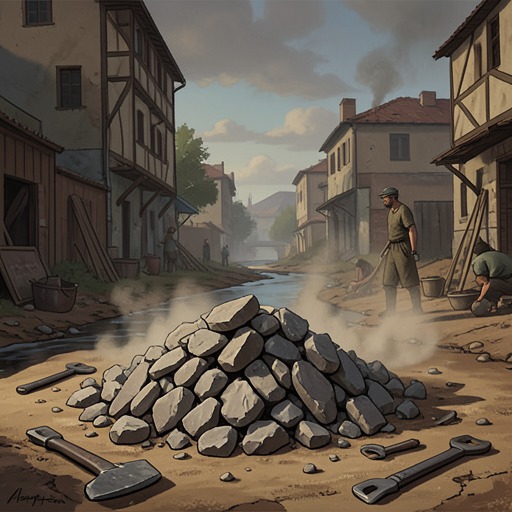
A month of excavation brought up about 1,250 blocks in varying states of wear. Most were carved megaliths with curved upper and lower surfaces. Others were smaller, flatter floor-like pieces, square or octagonal in shape; a few massive curved or slanted fragments suggested arches, vaulting, or round window casings. More blocks appeared the deeper the party dug and the farther north and east it moved, but the excavators could not establish how the stones had been arranged. Dyer was struck by their immense age, while Freeborn identified markings that seemed to connect with ancient Papuan and Polynesian traditions.
The party’s attempts to read the landscape from above were inconclusive. Wingate Peaslee used an aeroplane to search the shifting sand for large-scale outlines, but apparent patterns vanished or changed on later flights. Some fleeting formations nevertheless stirred Peaslee’s sense of recognition, linking the unstable desert surface to images he could no longer place. In this setting, even the failure to find a clear plan became part of the mystery: the stones survived, but their original order and the larger structures they might have belonged to remained hidden.
Ruins and deep time
The blocks’ materials and condition suggested a history extending far beyond ordinary human records. Mackenzie identified sandstone and granite among them, as well as one fragment that seemed to be made of an unusual cement or concrete. Water-worn surfaces led him to suppose that the region had once been submerged and later emerged. He estimated that the stones might be hundreds of thousands of years old, or older; the expedition’s discoveries intensified rather than resolved the sense of geological and historical scale.
Peaslee understood the ruins through traditions and memories that described successive dominant races on Earth. In those accounts, humanity was only one of many highly developed forms of life across the planet’s long history. The Great Race of Yith, in particular, was said to have mastered the projection of minds through time and to have assembled records of species, languages, arts, and techniques from different eras. The story also connected the Great Race’s arrival on Earth with its defeat and confinement of the Elder Things, who had built cities before being driven into subterranean depths. These claims form the mythic background against which Peaslee interprets the Australian masonry; they are not conclusions established by the excavation alone.
The underground discovery and its uncertainty
The expedition’s surface finds prompted Peaslee to explore a buried ruin. He later said that, in an underground chamber, he pried a metal case from an undisturbed deposit of ancient dust. Inside was a book whose brittle, discolored pages bore familiar English letters. The writing, he reported, was his own. This is the decisive revelation of his Australian experience: the ruins seemed to preserve not merely a civilization like the one in his dreams, but a material trace of his own identity across an immense span of time.
Peaslee’s account does not make the discovery independently verifiable. He lost the metal case and did not bring the book back, and the underground corridors had not been found by the time he wrote. He acknowledged that exhaustion, fear, and his history of dreams might have shaped what he believed he saw; at the same time, he could not dismiss the experience as hallucination. Western Australia therefore remains both a place of concrete archaeological evidence—the scattered blocks—and the setting of a revelation whose strongest proof has disappeared. The contrast between surviving stone and lost testimony leaves the ruins poised between geological fact and Peaslee’s terrifying interpretation of it.